The Structurally Upward Shift in Memory ASP Driven by HBM
High Bandwidth Memory (HBM) has become a defining technology in modern computing architectures. As HBM adoption grows across GPUs, AI accelerators, and high-performance CPUs, it is doing more than just increasing raw throughput. HBM is driving a structural upward shift in the memory Application Service Profile (ASP)—the way systems expose, package, and price memory as part of broader computing platforms.

What is Memory ASP and why it matters
Memory ASP (average selling price) traditionally refers to the cost per gigabyte of memory modules such as DRAM DIMMs. For many years, the market treated memory as a commodity: performance differences were primarily capacity and speed, and procurement focused on cost per gigabyte. The broader system economics—processor, interconnects, cooling, and software—absorbed memory as a line-item cost.
HBM changes that model. Instead of being a commodity line item, memory becomes integral to system architecture. Its positioning—stacked dies, advanced interposers, and tight packaging—creates differentiation across platforms and applications. As a result, pricing, value, and procurement practices shift upward: systems built with HBM command higher total ASPs because memory contributes directly to system-level performance, power efficiency, form factor, and even the software experience.
How HBM differs from traditional memory architectures
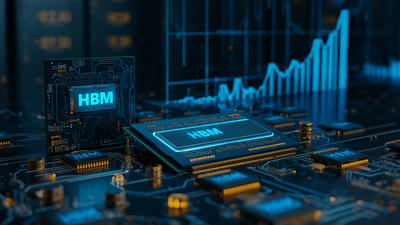
Understanding the upward ASP shift requires a quick comparison between HBM and legacy memory approaches.
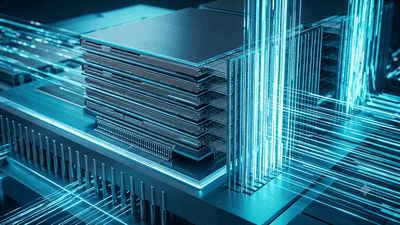
- Form factor and integration: HBM uses vertically stacked DRAM dies connected by through-silicon vias (TSVs) and a high-density interface to the host die (often across an interposer). Traditional DDR uses discrete DIMMs connected via the memory bus. HBM’s physical integration reduces latency and increases bandwidth per watt.
- Bandwidth density: HBM delivers much higher bandwidth per millimeter of PCB area compared with DDR. For bandwidth-bound workloads (AI training, inference, high-performance graphics), HBM enables designs that would be impossible with DIMMs alone.
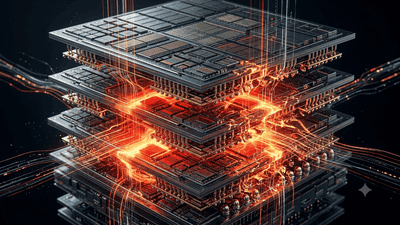
- Power and thermal profile: HBM’s proximity to the processor reduces signaling power and can be more power-efficient at delivering the same bandwidth. However, concentrated power density within the package creates new thermal management requirements.
- Cost structure: HBM production requires advanced packaging, additional test flows, interposers, and closer collaboration across fabs and OSATs (outsourced semiconductor assembly and test). These elements raise unit costs relative to commodity DIMMs.
Drivers of the ASP uplift
Several forces combine to lift memory’s ASP when HBM is involved.
- Technical differentiation: HBM is not interchangeable with DDR for many workloads. Systems designed around HBM deliver concrete, measurable advantages—higher throughput, lower latency, and better energy efficiency—making vendors able to charge a premium.
- System-level bundling: HBM typically ships as part of a tightly integrated package (processor + interposer + memory stack), often sold as a single SKU. Buyers pay for the combined value rather than just for memory capacity, raising the average price associated with memory per unit of compute.
- Supply chain complexity: The manufacturing and packaging steps for HBM introduce specialized supply constraints. Limited production capacity, yield variability, and higher upfront tooling drive higher marginal costs that translate into higher ASPs.
- Market segmentation: HBM initially targets premium segments—data centers, AI, HPC, high-end graphics—where customers prioritize performance and can absorb higher prices. As HBM moves down the stack, its price point may soften, but the structural uplift at the top tiers persists.
Economic implications for OEMs and system integrators
Original equipment manufacturers (OEMs) and system integrators must rethink cost models and product strategies when HBM becomes a core part of designs.
- Pricing and product tiers: OEMs can offer differentiated tiers using HBM-enabled SKUs. A single platform may include variants with and without HBM, each targeted at different customer segments and priced accordingly.
- Value-based selling: Sales teams must shift from capacity-focused pitches to value-based conversations that quantify latency, throughput, and energy efficiency benefits in terms customers care about—time-to-train, throughput per rack, and operating expense reductions.
- Inventory and supply planning: HBM’s constrained supply and higher unit cost require tighter inventory control, longer procurement cycles, and contingency planning for yield variability or supplier disruptions.
- Warranty and lifecycle: Higher upfront memory investment changes lifecycle economics. OEMs will need to account for field reliability, replacement strategies, and potential trade-in paths that preserve residual value.
Software impacts: making use of abundant on-package memory
Hardware only realizes its value when software adapts. HBM drives a set of software-level changes that further entrench the memory’s premium position.
- Memory-aware scheduling: Operating systems, hypervisors, and cluster schedulers evolve to place memory-bandwidth or memory-locality-sensitive workloads on HBM-enabled nodes. This increases the effective value of HBM-equipped systems.
- Data placement and hierarchical memory models: Applications must explicitly manage multiple memory tiers—on-package HBM, off-package DDR, and persistent memory. Libraries and runtimes (for example, those used in machine learning frameworks) implement placement policies to keep hot working sets in HBM for maximal performance.
- New programming models: Unified memory and memory tiering APIs give developers tools to exploit HBM without deep hardware expertise. However, high-performance code paths often require explicit optimization to hit peak HBM efficiency, which increases the development value proposition.
- Cost-driven optimization: Because HBM contributes significantly to system ASP, customers care about utilization. Software-driven multiplexing (time-slicing memory-intensive tasks) and virtualization approaches aim to maximize HBM utilization across workloads.
Case study: AI training clusters

AI training provides a clear example of how HBM drives an upward shift in memory ASP and why that shift is sustainable.
- Performance sensitivity: Large language models and dense neural networks are often bound by memory bandwidth and on-chip capacity. HBM-equipped accelerators deliver substantial reductions in training time, translating directly into lower compute-day costs.
- Rack-level economics: A rack filled with HBM-accelerated servers can finish a training job in fewer nodes and less energy. Buyers evaluate ASP at the rack level rather than per-component; higher memory cost is offset by fewer racks, lower networking overhead, and faster time-to-insight.
- Service differentiation: Cloud providers and AI platform vendors list HBM as a premium feature. Customers are willing to pay for HBM-enabled instances because the platform-level cost per training job falls, even if the per-unit ASP is higher.
Thermal and reliability trade-offs
HBM’s concentrated power and thermal density create design challenges that influence ASP.
- Cooling infrastructure: Systems must provision more robust cooling—improved thermal interface materials, enhanced heatsinks, liquid cooling in high-density deployments. These add to total system cost and thereby to the price tag associated with HBM-equipped systems.
- Reliability engineering: Tighter integration raises the stakes for component failure modes. Vendors invest more in testing, validation, and error correction mechanisms to preserve warranty commitments, driving up upstream costs.
- Field service complexity: Replacing a failed HBM stack is more complex than swapping a DIMM. Maintenance contracts, spares provisioning, and logistics reflect that complexity in higher support pricing and longer lead times.
Downstream effects on the DRAM market and price dynamics
The rise of HBM has measurable effects on the broader DRAM market.
- Segmentation of demand: DRAM suppliers allocate capacity between commodity DDR and HBM. Higher margins in HBM encourage suppliers to invest in packaging and TSV production lines, potentially reducing commodity DRAM supply and pushing DDR ASPs up in tight markets.
- Investment patterns: Capital expenditures shift toward advanced packaging and node optimization for low-power, high-density HBM stacks. This concentrates supplier expertise and creates a feedback loop favoring further HBM adoption.
- Innovation incentives: As HBM captures higher ASPs, OEMs and foundries pursue next-generation stacking (HBM3E, HBM4) and new interconnects, accelerating technological progress but also widening the gap between premium and commodity memory.
When the upward shift normalizes
Not all of the ASP uplift is permanent. Economic forces will moderate the premium over time as volumes increase and rival technologies emerge.
- Economies of scale: As HBM production ramps, tooling costs amortize and yields improve. This reduces manufacturing premiums and narrows ASP gaps.
- Alternative architectures: Innovations such as on-chip caches with larger capacities, chiplet-based DDR architectures, or emerging non-volatile memories might offer some of HBM’s benefits at lower cost—tempering the price premium.
- Market migration: As HBM becomes more common beyond the top-tier segments, its price will decline, but the accumulated system-level expectations about memory performance will keep a structural premium relative to older commodity norms.
Strategic recommendations for stakeholders
Different players in the ecosystem should consider tailored strategies to navigate the upward ASP shift.
- System architects: Design configurable platforms that can accept HBM-enabled modules or HBM-inclusive SKUs. Expose software hooks for memory tiering to maximize hardware value and support both premium and cost-sensitive customers.
- OEMs and vendors: Build clear value propositions around HBM. Offer benchmarks that translate memory features into operational savings and time-to-result. Plan procurement with supply chain diversification and long-term supplier agreements.
- Software developers: Invest in memory-tier-aware optimizations and abstractions. Implement fallbacks that allow good performance on non-HBM platforms while unlocking superior performance on HBM-equipped systems.
- Buyers and procurement teams: Evaluate total cost of ownership (TCO) at the workload level. Consider metrics like time-to-train, energy-per-inference, or throughput-per-rack rather than per-GB memory price alone.
Outlook: memory as strategic silicon
HBM’s rise signals a larger industry shift: memory is becoming strategic silicon rather than a passive commodity. The result is a structural upward movement in the memory ASP when HBM is part of the value chain. That movement reflects real system-level benefits—reduced latency, higher bandwidth, better energy efficiency—and is reinforced by supply chain dynamics, packaging complexity, and market segmentation.
For designers, vendors, and buyers, the response is to treat memory decisions as architectural choices with long-term implications. Product roadmaps must account for HBM’s unique thermal, integration, and software behaviors. Procurement must view memory not only as capacity but as capability. And software must evolve to exploit tiered memory hierarchies effectively.
Ultimately, whether you’re building AI clusters, HPC systems, or compact graphics solutions, HBM pushes memory into the foreground. The resulting higher ASPs will reflect a durable shift in how the industry values and prices memory—at least for the foreseeable future—while continuing to reshape the economics of performance-driven computing.